Throughout the history of Middle Eastern wars, one strategic mistake has been repeated time and again: great powers achieve victory on the battlefield, only to give their defeated adversaries an opportunity at the negotiating table to transform military defeat into political triumph. President Donald Trump faces precisely this danger. After eight months of war, the Islamic Republic of Iran, despite suffering devastating military and economic losses, continues to seek political survival through nuclear blackmail, threats to global energy security and the deliberate prolongation of negotiations. Washington must not allow a regime that has paid a heavy price for its reckless adventurism to regain, through a hastily negotiated agreement, the very position it occupied before the war.
The developments of Oct. 20 demonstrate that Tehran has abandoned none of its familiar tactics of confrontation, intimidation, bluffing and extortion. On the one hand, Islamic Republic officials speak of negotiations and ending the war; on the other, they impose imaginary conditions on Washington that, if accepted without credible guarantees, could dismantle much of America’s leverage.
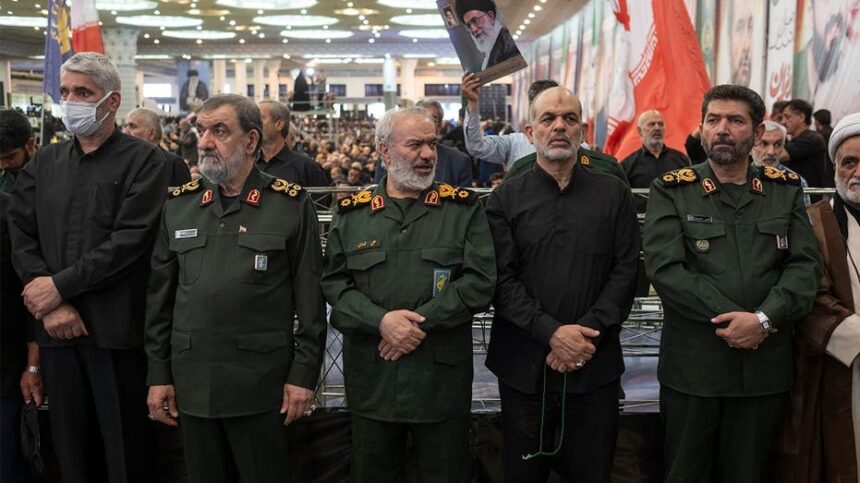
Mohsen Rezaei, secretary of the Islamic Republic’s Supreme National Security Council â a former terrorist affiliated with the Islamic terrorist group Mansouroun, who even sought to visit the United States in the 2000s but was opposed by the CIA â emphasized during his meeting with Pakistan’s army chief that not a single gram of Iran’s enriched uranium would leave the country.
Meanwhile, Abbas Araghchi â a former Islamic Revolutionary Guard Corps member acting as foreign minister â has made reopening the Strait of Hormuz conditional upon acceptance of Tehran’s proposed plan. Far from demonstrating a genuine willingness to compromise, these positions reveal the regime’s determination to preserve its instruments of coercion on the eve of a potential agreement.
The most significant issue, however, lies in the political calculations of the Islamic Republic’s rulers. Tehran is deliberately dragging out negotiations to weaken Trump’s political standing ahead of the Nov. 3 midterm elections â in other words, to exert psychological pressure on the American president.
This is no longer merely a dispute over centrifuges or economic sanctions. The Islamic Republic is attempting to weaponize the exhaustion of war, the anxieties of American voters and rising energy costs as instruments of political pressure against the president of the United States. Such calculated deception must be understood in Washington as part of Tehran’s asymmetric warfare strategy, not dismissed as an ordinary diplomatic tactic.
The Strait of Hormuz stands at the center of this calculation. The terrorist organization known as the Islamic Revolutionary Guard Corps has claimed â without presenting any evidence â that Iranian naval mines prevented three oil tankers from passing through the waterway. Nevertheless, the widespread disruption of regional shipping is an undeniable reality.
The Islamic Republic understands perfectly well that it does not need to win a conventional naval battle to inflict economic pain on the United States. It need only increase the risks facing oil tankers, drive up insurance and transportation costs, and keep global energy markets trapped in uncertainty. Under this strategy, commercial tankers become hostages to Tehran’s security calculations, while American consumers pay the price of the Iranian regime’s policies at the gas pump.
This is the very essenc